30–60 Day Business Plan for Strength Coaches to Launch Flagship Offer

The leanest, most effective strength coach business plan fits on two or three pages and answers four questions: who you serve, what single flagship offer you sell them, how you consistently fill your calendar with qualified calls, and what the numbers need to look like to hit your income target. Everything else, from branding to legal registration, exists to support those four pillars. Build the plan around your target client, your offer, and a repeatable funnel before you touch spreadsheets or software.
TL;DR:
- A strength coach business plan should focus on defining your target client, flagship offer, marketing funnel, and financial goals within a concise six-section format.
- Your chosen business model—whether in-person, online, hybrid, or subscription—dictates your client capacity, pricing strategy, and operational systems.
- Building a high-ticket, outcome-based program with clear results, timeframe, and upfront pricing increases client retention and lifetime value.
- A content-to-DM-to-call funnel is the most effective method for consistently filling your calendar with qualified discovery calls and sales.
- Proper onboarding, scalable programming, automation, and client retention strategies are essential for improving delivery quality and supporting business growth.
1What should a strength coach business plan include?
Forget the 20-page document with market analysis charts nobody reads twice. A working strength coach business plan is a tool you open every Monday, not a file you write once and bury. It needs six sections, each answerable in a paragraph or two, and a checklist that turns the writing into action within 30 to 60 days.
Here is the fillable structure, with a working example for each heading:
- Mission and niche. One sentence on who you help and the transformation you deliver. Example: “I help time-poor tradespeople build strength and lose fat in three 45-minute sessions a week.”
- Ideal client profile (ICP). Age range, training history, budget, and the specific frustration that makes them search for a coach.
- Flagship offer. Name it, price it, and state the outcome and timeframe. Example: “12-Week Strength Reset, delivered online with weekly check-ins.”
- Pricing and packages. Your core price plus one upsell (extended access, nutrition add-on, in-person top-up).
- Customer journey. How a stranger becomes a lead, a lead becomes a call, and a call becomes a client.
- Operations and financials. Tools you use daily, and the break-even client count you need each month.
A lean plan like this beats a lengthy document precisely because you will actually revisit it.
Map that structure to a 30 to 60 day launch window:
- Days 1 to 10: Write your mission, lock your niche, and draft the flagship offer with a real price attached.
- Days 11 to 20: Build your customer journey. Post three pieces of content a week that speak directly to your ICP’s problem, and set a single call-to-action keyword for comments.
- Days 21 to 40: Turn on a comment-to-DM automation, reply manually where automation is not yet set up, and start booking discovery calls.
- Days 41 to 60: Refine pricing based on real conversations, document your onboarding process, and calculate your break-even client count.
Pro Tip: Write your flagship offer before you write anything else. A plan without a priced, named offer is a wish list, not a business document.
2Choosing a business model: pick the structure that matches your goals
In-person, online, hybrid, and subscription models are not interchangeable; each one sets a hard ceiling on how many clients you can serve and how your income scales. In-person coaching caps out fast, usually at a limited number of weekly client hours once you account for programming and admin time. Online coaching removes that ceiling almost entirely, because delivery does not require your physical presence, but it demands stronger systems to maintain quality at volume.
Hybrid models split the difference: in-person sessions for the work that benefits from hands-on coaching (technique-heavy lifts, injury return-to-play) and online delivery for programming, check-ins, and accountability. Subscription models, where clients pay a recurring monthly fee for ongoing access rather than buying a fixed-length programme, smooth out your revenue but require you to prove ongoing value every single month or watch cancellations climb.
Each model changes what you charge and how you sell:
- In-person justifies premium hourly or session-block pricing because your time is genuinely scarce, but growth means raising prices, not just adding clients.
- Online competes on transformation and convenience rather than proximity, which means your marketing has to work harder to build trust without a handshake.
- Hybrid lets you charge a premium for the in-person component while using online delivery to serve a wider geographic pool.
- Subscription needs a retention engine, because monthly billing means every cancellation directly hits recurring revenue, not just a one-off sale.
Run through this checklist before committing to a structure:
- Do you want to cap your income at what your calendar can hold, or build something that scales past your own hours?
- Is your genuine strength lies in the room (coaching cues, spotting, real-time technique correction) or in programme design and communication?
- Can you tolerate the higher churn risk that comes with subscription pricing, or would you rather sell fixed-length programmes with a clear end date?
- Do you have (or want to build) the systems needed to deliver personalised coaching to dozens of online clients at once?
Most coaches starting out choose hybrid or fixed-length online programs, balancing in-person credibility with online scalability. Whichever you choose, write it into your plan explicitly. The model dictates the rest of your pricing, marketing, and operations decisions, so guessing at this stage costs you months of misaligned effort later.
3Design offers and price for transformation, not minutes
Selling hourly sessions caps your income at the number of hours in your week. Selling a priced outcome does not. High-ticket, multi-week programmes convert better than hourly billing because the client is buying a result, not a slot in your diary, and structuring the offer around outcome, timeframe, delivery, and one clear price removes the friction of negotiating rates every session.
Build your flagship offer using four fixed fields:
- Outcome: the specific, measurable result (add 20kg to your squat, drop two waist sizes, return to sport pain-free).
- Timeframe: Programs typically last for several weeks, balancing effective strength gains and buyer comfort.
- Delivery: exactly how sessions, check-ins, and programming reach the client (weekly video calls, app-based programming, in-person blocks).
- Price: one number, quoted upfront, with no “it depends” hedging.
A fixed-price, outcome-led program also raises lifetime value because the client pays for the full arc of transformation rather than deciding week to week whether to book another session. That single decision point, made once at the point of sale, is worth more to your cash flow than a dozen smaller transactions you have to keep re-selling.
On pricing itself, a few rules hold up across most coaching niches:
- Price the outcome relative to what it is worth to the client, not to your hourly rate divided across sessions.
- Anchor your flagship offer in a mid-tier band relative to your local market, then let testimonials and results justify moving upward.
- Offer one upsell, not five. A nutrition add-on or an extended access tier works; a menu of seven options creates decision paralysis.
- Raise your price the moment you have three or more consistent client results to point to. Waiting for “confidence” instead of proof leaves money on the table.
Pro Tip: Write your price on the page before you talk yourself out of it. Coaches who under-price their flagship offer at launch almost always regret it within three months, once demand outpaces their calendar.
Resist the temptation to build a complicated tiered pricing table before you have sold anything. Sell one offer, get it right, then add tiers once you understand what clients actually ask for.
4Client acquisition: build a content → DM → call funnel
The single highest-leverage acquisition system for a strength coach is a content-to-DM-to-call funnel, because it turns a piece of content into a conversation, and the conversation into a booked call, without you chasing anyone. Content’s job is to start that conversation, not to close the sale on its own.
Here is how the mechanics work in practice:
- Post content that names the exact frustration your ICP has. A caption ending in “comment STRENGTH and I’ll send you the plan” gives followers one clear action.
- Use a comment-to-DM automation trigger so that keyword comment fires an automatic direct message, opening a conversation without you manually replying to every comment.
- Qualify inside the DM before offering a call. Ask two or three questions: current training history, main goal, and budget range, so you protect your calendar from unqualified enquiries.
- Book the call only once qualification checks out. This is where the sale actually happens, not in the DM itself.
This exact pattern, posting three reels a week, enabling a DM trigger, qualifying manually at first, then automating once volume grows, fills a calendar with discovery calls faster than posting volume alone ever does. Volume without a clear next step just generates likes; a single CTA keyword generates conversations.
Qualifying questions worth using verbatim in your DM script:
- “What’s the main thing you’re trying to fix or achieve in the next three months?”
- “Have you worked with a coach before, and what worked or didn’t work?”
- “Are you looking to invest in a structured programme, or just after free tips for now?”
That last question alone filters out a large share of time-wasters before they reach your calendar.
Once your funnel is live, watch three metrics weekly rather than obsessing over follower count: comment-to-DM conversion rate, DM-to-call booking rate, and call-to-client close rate. If comments are high but DMs stall, your automation trigger is likely broken. If DMs are strong but calls are not booking, your qualifying questions are too soft or your call-booking link is buried too deep in the conversation.
Beyond Instagram and TikTok, three channels are worth testing in parallel: local gym partnerships (cross-referral with PTs who do not do strength specialism), a simple email list built from a lead magnet, and community Facebook groups where you answer questions with genuine expertise rather than pitching. Pick one primary channel and one secondary channel. Trying to run five channels at once with no team is how most solo coaches burn out before their funnel ever proves itself. Most successful online coaches focus on one niche, one channel, and one offer when they start, and diversify only once that combination is proven.
5Delivery and operations: onboarding, programmes and the tools to run them
Your funnel is worthless if delivery falls apart the moment clients arrive. Build a repeatable onboarding sequence before you need one, not after your third client asks why nobody has replied to their intake form.
A solid onboarding flow runs in five steps: intake questionnaire (goals, injury history, equipment access), a welcome call or video confirming the programme and expectations, first programme delivered within 48 hours, a check-in cadence agreed upfront (weekly video, biweekly call, whichever suits your model), and a simple dashboard where the client can see their programme, progress photos, and check-in history in one place.
That last point matters more than it sounds. Integrated dashboards and automated check-in summaries reduce the context-switching that eats coaching time as your roster grows, letting you spend saved minutes on genuine programme adjustments rather than hunting through spreadsheets and message threads for last week’s numbers.
Segmentation is what makes scale possible without your quality collapsing. Rather than hand-writing every programme from scratch, build three or four templates matched to common client profiles (beginner strength, return-from-injury, intermediate hypertrophy-strength hybrid, advanced competition prep) and adjust each template with targeted manual tweaks per client. Genuine personalisation at scale depends on strong templates plus focused manual adjustment, not bespoke programming for every single person on your books.
When you evaluate software, model the cost at three rosters, not just your current size:
- At 20 clients: almost any platform works; the priority is ease of use and your own learning curve.
- At 50 clients: pricing structure starts to bite, because flat-tier platforms suddenly look cheap next to per-client pricing that scales against you.
- At 100 clients: percentage-of-revenue models can quietly become your largest line item, sometimes larger than payment processing fees.
Pro Tip: Choose your client management platform based on its cost at 100 clients, not at 20. Switching platforms mid-growth costs you weeks of migration and a wave of client confusion.
6Finance and projections: break-even, client counts and 12-month modelling
You do not need an accountant’s spreadsheet to know whether your coaching business works. You need two numbers: your monthly fixed costs, and your average client value. Divide the first by the second and you have your break-even client count.
Start with your cost categories:
- Fixed costs: software subscriptions, insurance, website hosting, any studio or gym rental.
- Variable costs: payment processing fees, referral commissions, paid advertising spend.
- Gross margin: your flagship price minus the variable cost to deliver it (processing fees, platform per-client charges).
A worked example makes this concrete. Calculate break-even client count by dividing fixed monthly costs by net revenue per client to understand how many clients cover overheads and start generating profit.
Build multiple client-growth scenarios over a year including conservative, realistic, and stretch cases with varying new client acquisition and churn rates. Run each scenario against your break-even number to see how much cushion you actually have in a bad month.
On cash flow, the most common mistake is treating a full programme payment as available income the day it lands. If a client pays £450 upfront for a 12-week programme, that money has to cover 12 weeks of delivery, not one week of your own spending. Set aside a rough delivery-cost reserve from every upfront payment before you draw anything as personal income.
7Scaling: when to productise, automate or hire
Coaches typically hit a systems plateau somewhere between 30 and 50 clients, where the manual workflow that worked at 15 clients starts collapsing under its own weight. The fix is not more hours. It is productisation, automation, and selective hiring, applied in roughly that order.
Productisation means turning your one-to-one delivery into something that serves more people per hour of your time: a group coaching cohort, an on-demand programme library, or a template pack clients follow with lighter-touch check-ins. It makes sense once you have a proven flagship offer and a waiting list you cannot serve one-to-one fast enough.
Automation should target the repetitive admin, not the coaching itself:
- Automated onboarding sequences (intake forms, welcome emails, programme delivery).
- Scheduled check-in reminders so clients submit data without you chasing them.
- DM funnel automation, already covered above, running continuously in the background.
- Template-based programming with manual adjustment layered on top.
Hiring comes last, and only for one of two reasons: you need delivery capacity (a second coach) or you need admin capacity (a client success or ops person) to protect your own coaching time. Whichever you hire first, set a clear KPI before day one: a new coach hire should be generating enough client revenue within 90 days to cover their cost plus a margin, not just filling a gap on the org chart.
8Retention and the client roadmap: reduce churn with a visible plan
A client roadmap, a phased 6 to 12 month plan with clear milestones, is a stronger retention tool than a string of short, disconnected programmes, because visible long-term progress reduces the uncertainty that drives most cancellations.
Build the roadmap in three or four phases: foundation (weeks 1 to 8, movement quality and baseline strength), development (weeks 9 to 20, progressive overload toward the client’s stated goal), and consolidation (weeks 21 plus, either a maintenance phase or a fresh goal-setting conversation). Attach a specific milestone to each phase transition, a strength benchmark, a body composition marker, or a performance test, so the client sees measurable proof they are moving forward.
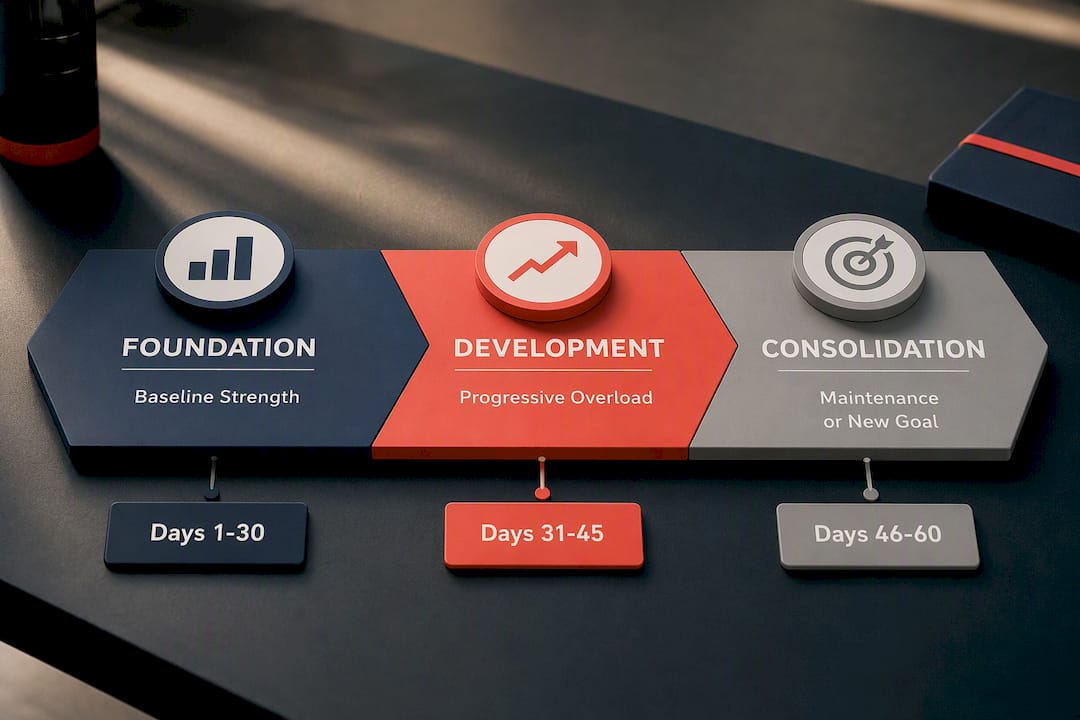
Make the roadmap visible inside delivery itself, not buried in a PDF sent once at onboarding. Reference it in check-ins (“you’re now entering phase two, here’s what changes”), and revisit it explicitly at each phase transition.
Track cohort retention by start month, and set intervention triggers: if a client misses two consecutive check-ins, that is your cue to reach out personally before they quietly disappear.
Pro Tip: A client roadmap works because it makes progress visible during the exact weeks that motivation naturally dips, not just at the finish line.
9How Strength and Conditioning Education helps you deliver on the plan
A business plan is only as strong as the coaching behind it. Strength and Conditioning Education offers courses from foundational S&C principles through to Level 4 and recognized strength and conditioning qualifications, each built to give your flagship offer real technical credibility. Fundamentals-level study strengthens your programming; business-focused modules and NSCA endorsement sharpen how you price and market that expertise. Graduates carry that credibility into professional sport and private coaching alike, with access to resources and a peer network to lean on as you scale.
10Legal and regulatory requirements for fitness businesses
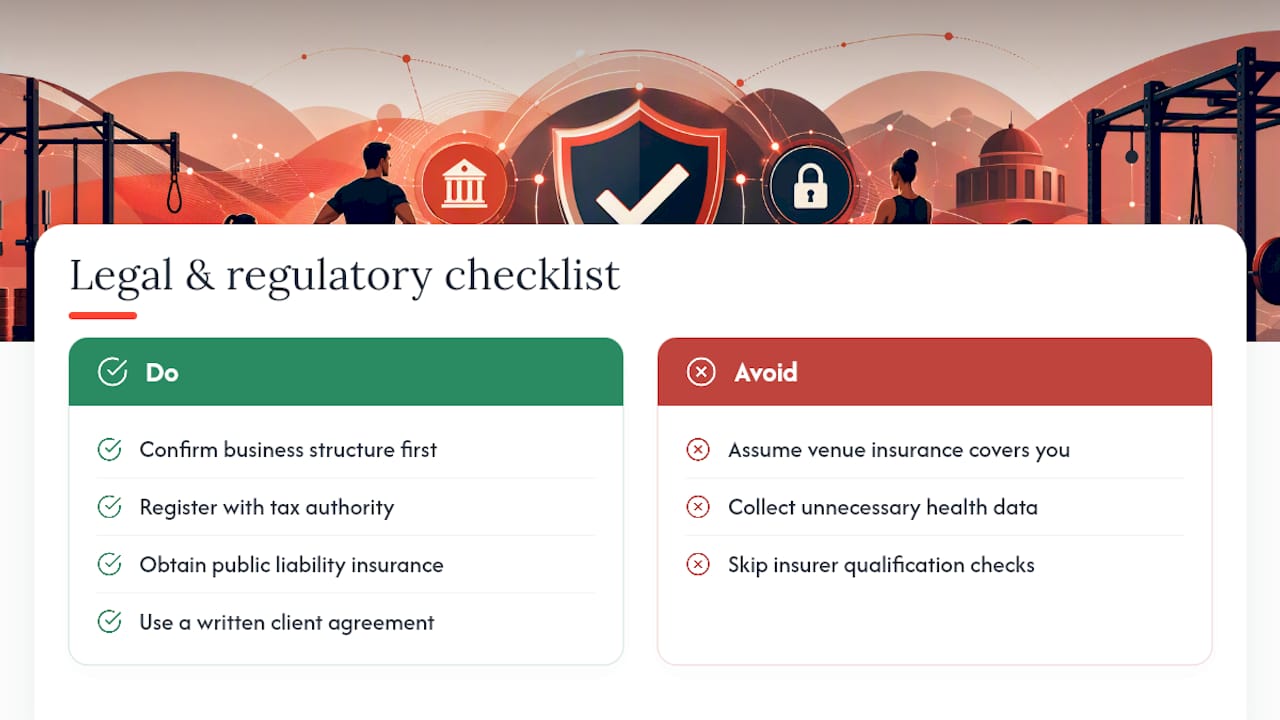
Before you take your first payment, confirm your business structure. Most solo coaches start as sole traders, which is the simplest registration route, while others incorporate as a limited company once income grows enough to justify the tax and liability differences. Either way, register with the relevant tax authority and keep clean records of income and expenses from day one.
Public liability insurance is not optional for anyone coaching clients in person, and professional indemnity cover protects you if a client claims your advice caused injury or loss. If you deliver group sessions in a rented space, check that space’s own insurance terms rather than assuming your policy covers everything.
Contracts matter more than most new coaches assume. A simple client agreement should cover payment terms, cancellation and refund policy, liability waivers, and data handling. If you collect health information (injury history, medical conditions) as part of intake, you have data protection obligations, so store it securely and only ask for what you genuinely need to programme safely.
Qualifications are a separate question from legal compliance, but they intersect with insurance in practice. Many insurers require a recognised coaching qualification before they will underwrite a policy, so your certification choice is not just a credibility decision, it is often a prerequisite for legally operating with proper cover. Check the specific requirements of your insurer and any gym or facility you plan to work from before assuming your existing qualifications are sufficient.
11Branding and marketing strategies beyond acquisition channels
Your DM funnel fills your calendar, but branding is what makes a stranger trust you enough to comment in the first place. Consistency is the unglamorous foundation: the same visual style, the same tone of voice, and the same core message across every platform you use, so a prospective client recognises you instantly whether they find you via a friend’s tag or a random search.
Positioning matters more than most coaches realise early on. “Strength coach” alone says almost nothing; “strength coach for postnatal athletes returning to sport” says everything. Specific positioning does two things at once: it makes your marketing easier to write, because you are speaking to one person’s exact situation, and it makes referrals easier, because clients can describe precisely who else you help.
Beyond your acquisition funnel, three branding moves compound over time:
- Case studies and testimonials, gathered systematically after every completed programme, not chased haphazardly when you remember.
- A simple lead magnet (a short PDF or video) that demonstrates your coaching philosophy before anyone books a call.
- Consistent publishing on one long-form channel (a newsletter, blog, or YouTube series) that builds authority slower but compounds further than short-form content alone.
Your credentials belong in your branding too. Listing a recognised qualification on your website and social bios is not just a compliance nicety, it is a trust signal that shortens the distance between a stranger’s first comment and their decision to book a call.
12Technology and equipment needs specific to strength coaching
Strength coaching has its own equipment logic, whether you deliver in-person, online, or hybrid. In-person coaches need a barbell platform, calibrated plates, a rack system, and reliable timing or velocity-tracking tools if you programme with any precision around load and speed. Online coaches need almost none of that physically, but they need a way to assess technique remotely, which usually means a video submission workflow built into your client dashboard.
On software, three categories matter regardless of your model: programming software to build and deliver plans, a communication and check-in system for ongoing accountability, and payment processing that handles recurring billing cleanly if you run a subscription model. Evaluate every platform against the cost-at-scale logic covered earlier, because a tool that feels cheap at 20 clients can become your biggest line item at 100.
Video is now close to essential, not optional. Whether it is a weekly Loom-style check-in or a live call, video communication builds the trust that text messages alone struggle to replicate, particularly for online clients who never meet you in a gym.
Do not over-invest early. A new coach does not need enterprise-grade force plates or a full home studio before signing their first client. Start with what your flagship offer actually requires to deliver a genuinely good result, then reinvest in equipment and tools as revenue proves the demand exists.
13Risk management and insurance considerations
Every strength coach carries physical risk that a desk-based coaching business does not. Clients lift heavy things, sometimes with imperfect technique, sometimes with pre-existing injuries they did not fully disclose. Public liability and professional indemnity insurance, mentioned earlier as a legal requirement, is also your primary risk management tool, and it should be treated as a genuine budget line rather than an afterthought.
Screening reduces risk before it becomes a claim. A thorough intake questionnaire that captures injury history, current medications, and any red-flag symptoms lets you adjust programming before the first session, not after an incident. For clients with complex medical histories, a simple sign-off from their doctor before you begin heavy loading is a reasonable and professional precaution, not an overreaction.
Financial risk deserves the same attention as physical risk. Concentration risk, where one or two clients represent a large share of your monthly income, leaves you exposed if either cancels. Spreading your client base and maintaining the funnel consistently, even when your calendar feels full, is the practical hedge against that exposure.
Data risk is smaller but still real. Client health information, payment details, and programme data all need secure storage, whether that is a dedicated coaching platform or a properly protected spreadsheet system, not a shared document with no access controls.
14Detailed budgeting: startup and recurring costs
Startup costs for an online or hybrid strength coaching business are lower than most people assume, but they are not zero, and undercounting them is a common early mistake. Expect to budget for a website or landing page, initial insurance premiums, a coaching platform subscription, a professional logo and basic brand assets, and any qualification costs if you are still completing your certification pathway.
Recurring monthly costs typically include your coaching platform subscription, payment processing fees (usually a percentage per transaction), insurance premiums, and any paid content or advertising spend once your organic funnel is proven and you choose to accelerate it. Add a modest reserve for software you have not yet identified you need. Most coaches discover a gap in their tech stack, usually around client communication or video hosting, within the first three months.
Build your budget around the break-even model covered earlier rather than guessing at round numbers. If your fixed monthly costs total £450 and your flagship offer nets £380 per client, your recurring cost base tells you exactly how many clients you need before any spend becomes genuine profit. Revisit that number every quarter, because costs creep upward as you add tools, and your break-even count needs to move with them.
Keep a separate reserve, ideally one to two months of fixed costs, for the inevitable slow month. Client acquisition rarely arrives in a perfectly smooth line, and a cash buffer prevents one quiet month from forcing a panic price cut or a hasty pivot.
15A 30-day launch, in practice
Picture a coach specialising in strength for recreational rugby players. Week one: lock the niche, write the flagship offer (8-week off-season strength block, £320), and post the first piece of content naming the exact problem, pre-season injuries from poor off-season conditioning. Week two: enable the comment-to-DM trigger, reply manually while checking it works, and qualify the first five conversations. Week three: book four discovery calls, close two clients. Week four: refine the offer copy based on the objections heard on calls, and raise the price slightly for the next cohort.
What changed by day 30: the niche got sharper, not broader, and the qualifying questions in the DM script tightened after the first few unqualified leads wasted call slots. The immediate next step for any reader following this pattern is the same: write the offer before the content, and treat every DM conversation as data for refining the next one.
— Marketing
16Courses that help you build and run this plan
Writing the plan is one thing. Delivering on it with genuine technical authority is another, and that is where the right qualification changes what you can credibly charge. If you are early in your coaching career, Strength and Conditioning Fundamentals builds the programming competence your flagship offer depends on. If you are further along and ready to formalise your standing in the industry, an NSCA-endorsed pathway signals a level of credibility that supports the premium pricing this article has walked through.
Whichever stage you are at, the right course accelerates the parts of this plan that take longest to build alone: programming depth, client trust, and the confidence to price for transformation rather than minutes. Explore Strength and Conditioning Education’s course routes and pick the one that matches where your business actually needs strengthening next.
17Sources
- How to Start Online Fitness Coaching (2026) – SetSmart
- Client roadmaps for online fitness coaches
- Online fitness coaching: the complete guide (2026)
- How to personalise fitness coaching at scale | CoachingPortal Blog
