Long-term athlete development: the full stage-by-stage guide

Long-term athlete development is a staged framework for planning training, competition and recovery across an athlete’s entire sporting life, built to raise physical literacy, cut injury risk and keep people active well beyond their competitive years. Coaches use it to match what they ask of an athlete’s body to what that body is actually ready for. Get the staging right, and you build durable, well-rounded athletes. Get it wrong, and you either bore a talented eight-year-old with drills they’ve outgrown or push a fourteen-year-old through a training load their skeleton can’t yet handle.
This guide covers:
- What LTAD actually is, and where the model came from
- Each stage, with concrete coaching priorities
- The physiology behind “windows of trainability” and peak height velocity (PHV)
- How to turn the theory into real programming decisions
- Where the evidence is strong, where it’s shaky, and how to coach around the gaps
- Inclusive pathways so no athlete is left outside the model
Key Takeaways
Effective long-term athlete development depends on matching training demands to biological readiness rather than chronological age, using PHV and movement competence as the real planning markers.
| Point | Details |
|---|---|
| Stage over age | Use movement competence and PHV, not birth year, to decide training load and complexity. |
| Delay specialisation | Multi-sport sampling through FUNdamentals and Learn to Train builds a broader athletic base. |
| Monitor growth regularly | Track height every three to six months to catch PHV timing and adjust load through growth spurts. |
| Treat LTAD as a guide, not a rulebook | Longitudinal evidence for rigid windows is limited, so individualise continuously. |
| Formal education closes the gap | Strength and Conditioning Education’s NSCA-endorsed courses teach coaches to apply PHV-based planning and stage-appropriate programming directly. |
1What is athlete development? Origins and core principles of LTAD
The long-term athlete development model was developed by Istvan Balyi in the early 2000s, drawing on Eastern European sport science traditions that had long organised training around biological maturation rather than school-year age brackets. National governing bodies across the UK, Canada and Australia adapted it into their own long-term athlete development model frameworks over the following decade, which is why you’ll see slightly different stage names depending on the sport.
Staging matters because a ten-year-old and a fourteen-year-old are not simply “smaller” or “bigger” versions of an adult athlete. Their nervous systems, growth plates and hormonal profiles are doing fundamentally different work at each point, and training that ignores this tends to either underload capable young athletes or overload developing ones.
Four principles hold the model together:
- Physical literacy first. Fundamental movement skills, running, jumping, throwing, catching, balancing, are the foundation every later sport skill sits on. Skip this and athletes hit a ceiling later.
- Developmentally appropriate training. Sessions match biological readiness, not just chronological age or league grouping.
- Windows of trainability. Certain qualities, speed, skill acquisition, aerobic capacity, appear to respond more readily at specific developmental windows.
- System alignment. Clubs, schools and governing bodies coordinate competition calendars and coaching pathways so an athlete isn’t pulled in three directions at once.
Where LTAD genuinely helps is in giving clubs and national systems a shared vocabulary and a default sequencing logic. Where it falls short is the individual athlete in front of you: a framework built for populations still needs a coach willing to override the textbook when a specific young athlete’s maturation doesn’t match their age group.
2The seven stages of long-term athlete development, explained
Before the seven core stages begin, most modern LTAD models add two pre-stages, Awareness and First Involvement, aimed at getting people through the door in the first place. Awareness is about visibility: making sport and physical activity feel accessible and appealing to families who might not otherwise consider it. First Involvement is that crucial first taster session, engineered to be fun and low-pressure rather than a test of ability. Get these wrong and you lose people before the real development work even starts.
Here’s what happens at each of the seven stages that follow.
Active Start (roughly ages 0 to 6)
The aim here is simple: movement should be joyful and constant. Running, climbing, swimming, rolling, throwing, all of it, with zero focus on organised competition or skill correctness. Sessions should look like play, not training. The main risk at this stage isn’t injury, it’s inactivity; children who don’t move enough here often carry coordination deficits into later stages that are much harder to correct.
FUNdamentals (roughly ages 6 to 9)
Fundamental movement skills take centre stage: agility, balance, coordination, speed (the “ABCs”), taught through games rather than drills. Strength work at this age means bodyweight-based movement competence, not loaded resistance training. Competition should be informal and low-stakes; the moment a nine-year-old feels judged on results, engagement often drops. Individual variation is already visible here: some children are simply more physically confident than others of the same age, and that’s normal, not a red flag.
Learn to Train (roughly ages 8 to 12, sport-dependent)
This is widely considered the golden window for motor skill acquisition. Children at this stage absorb technical skill faster than they will at any later point, so it’s the stage to load up on skill variety and sport-specific technique across multiple activities, not to specialise. Strength training can now include light resistance work with proper technique supervision, and the evidence here is worth pausing on: reviewed data shows resistance training in pre- and early-pubertal youth produces substantial motor skill gains and can meaningfully cut injury risk when it’s appropriately prescribed. Competition should still be secondary to skill development; results at under-11 level tell you almost nothing about eventual athletic ceiling.
Train to Train (roughly ages 11 to 15, sport-dependent)
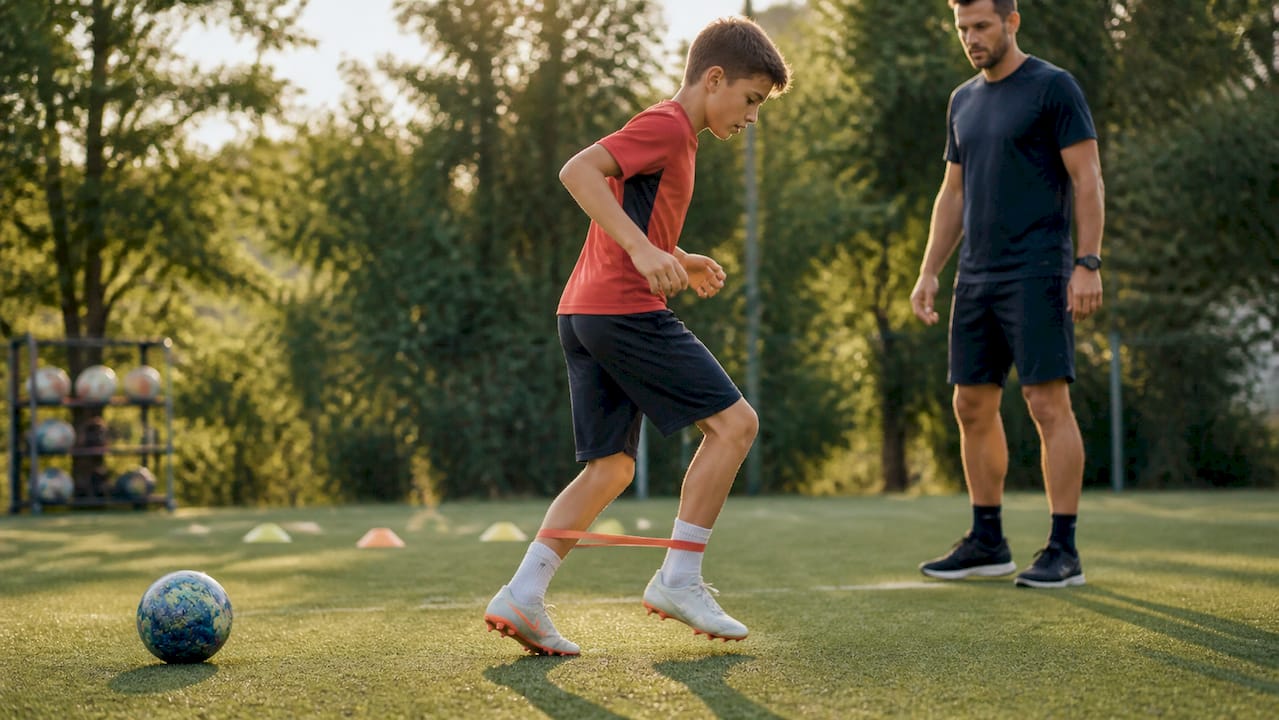
Puberty arrives somewhere in this stage for most athletes, and it changes everything about programming. This is when structured strength and conditioning becomes genuinely valuable, aerobic and anaerobic systems are both highly responsive to training here, but it’s also when growth-related injury risk climbs sharply. Session emphasis should shift toward building an aerobic base, introducing more structured strength work, and reinforcing movement mechanics under fatigue. Competition can increase in seriousness, but this is precisely the stage where chronological age stops being a reliable planning anchor; two athletes born six months apart can be biologically years apart in maturity.
Train to Compete (roughly ages 15 to 18, sport-dependent)
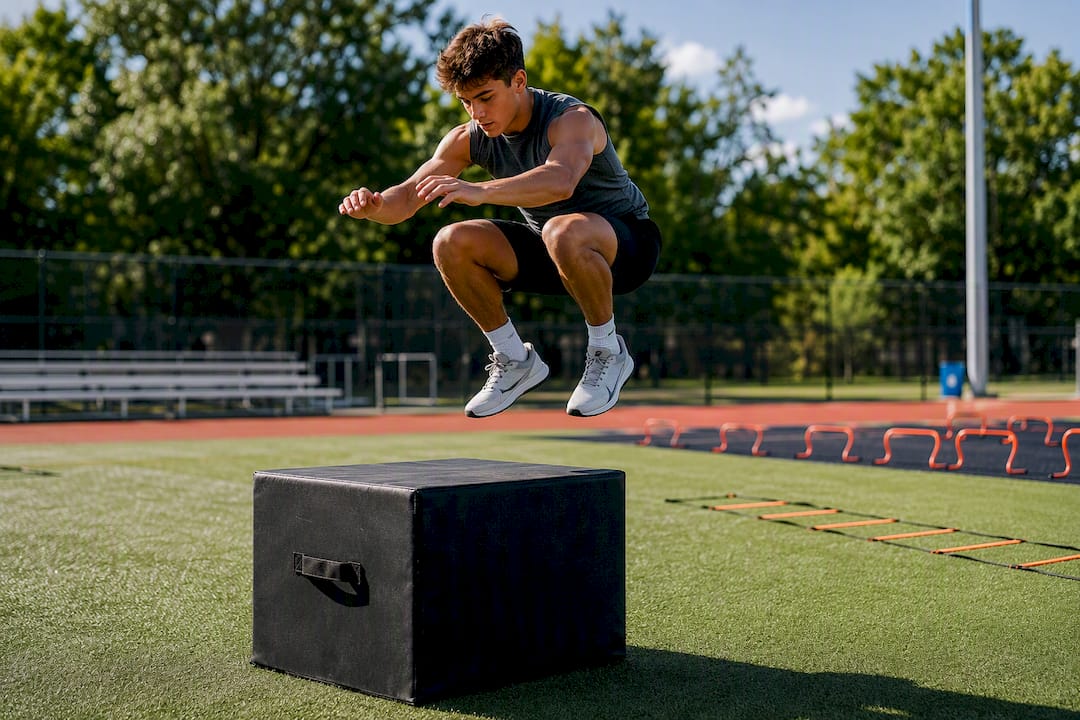
Training becomes sport-specific and performance-focused. Volume and intensity both rise, periodisation becomes a genuine necessity rather than a nice-to-have, and athletes start specialising in position or event. Competition is now central to the training plan rather than incidental to it. This is also where overtraining and burnout risk peaks if the earlier stages were rushed or skipped.
Train to Win (roughly age 18 and up)
Full specialisation, individualised periodised programming, and performance margins measured in fine detail. By this stage, training is built entirely around the individual athlete’s physiology, event demands and competition calendar rather than any generic template.
Active for Life (any age, entry possible at any stage)
Not every athlete, or every young person, is heading toward elite competition, and the model explicitly makes room for that. This stage covers three legitimate routes: staying competitive for life in masters or veteran categories, staying fit for life through recreational activity, or moving into coaching, officiating or volunteering. All three count as successful outcomes.
Across every stage, individual variation is the rule, not the exception. Two athletes at the same stage, same age, same sport, can need meaningfully different programming.
Don’t use the chronological age brackets above as strict gates. Use them as a starting orientation, then confirm with movement competence and, from puberty onward, maturation markers like PHV before you commit an athlete to a training block.
3Windows of trainability and PHV: what the physiology actually says
Windows of trainability describe periods when a physical quality, speed, skill acquisition, aerobic capacity, appears to respond more readily to training because of what’s happening biologically at that time. The idea has intuitive appeal and a plausible physiological rationale, but the caution here matters as much as the concept itself: peer-reviewed analysis concludes the model presents a coherent physiological rationale without strong longitudinal empirical support for treating these windows as fixed, universal cut-off points.
Peak height velocity (PHV) is the practical tool that makes the whole idea usable. It marks the point of fastest growth during a young athlete’s adolescent growth spurt, and it’s a far more reliable marker of biological readiness than birth date. Practitioner guidance recommends tracking PHV rather than relying on age alone to decide how much load an athlete can safely absorb through puberty.
In practice, coaches estimate PHV timing using standing and sitting height measurements taken every three to six months, plotted against age to spot the acceleration point. You don’t need a sports science lab for this. A tape measure, a spreadsheet, and a consistent measurement routine will get you most of the way there.
Around PHV, a few practical adjustments matter:
- Reduce high-impact volume during the fastest growth window, since bone is growing faster than the surrounding tendon and ligament can adapt to.
- Watch for asymmetry and complaints of joint pain, particularly around the knee and heel, which often signal growth-related overuse rather than a training-load problem alone.
- Prioritise movement quality checks over pushing new personal bests during rapid growth phases, since coordination often temporarily regresses as limb proportions shift.
- Keep communication open with parents about growth spurts, since a sudden drop in coordination or confidence is normal and not a sign the athlete is regressing as an athlete.
None of this means training stops during a growth spurt. It means load, volume and skill complexity get dialled to match what the athlete’s frame can currently absorb, then ramped back up once growth stabilises.
4Turning LTAD into a real training programme
Reading about stages is one thing. Building a season around them is another. Here’s how the theory becomes a workable plan.
- Start with the annual plan, then work down. Map the competition calendar first, then block the year into macro periods (general preparation, specific preparation, competition, transition) sized to the athlete’s stage. A Learn to Train athlete needs far more general preparation time relative to competition time than a Train to Compete athlete does.
- Break the annual plan into mesocycles. Four to six week blocks with a single primary emphasis each, aerobic base, strength foundation, speed development, work well for youth athletes because they avoid asking the body to adapt to too many stimuli at once.
- Build microcycles around recovery, not just load. A typical week for a Train to Train athlete should have clear hard, moderate and easy days, with at least one full rest day protected regardless of what competition schedule pressure suggests.
- Track readiness simply. A one-to-ten wellness score (sleep quality, muscle soreness, mood) filled in before training takes under a minute and flags overreaching well before an injury does.
- Log volume, not just intensity. Total weekly training and competition hours across all activities, not just the ones you coach, matter enormously for youth athletes who might be playing two or three sports at once.
- Re-measure growth every few months. Standing height, sitting height and weight, tracked against age, keep your PHV estimate current and flag when load adjustments are due.
- Communicate with parents and other coaches. An athlete’s football coach, swim coach and PE teacher are all loading the same body. Someone needs to see the whole picture.
On specialisation: delay it. The evidence consistently favours multi-sport sampling through the FUNdamentals and Learn to Train stages, since cross-sport movement variety builds a broader athletic base than early single-sport focus does. Practically, that means encouraging a young athlete to play football in winter and cricket or athletics in summer rather than pushing twelve months of one sport. It also means resisting parental and club pressure to specialise “to keep up” with peers who’ve already narrowed their focus, pressure that tends to peak right around the Learn to Train stage.
A quick coach checklist before locking in a programme: Does this plan match the athlete’s biological stage, not just their birth year? Is competition volume appropriate for this stage? Is there a rest day that survives contact with the fixture list? Have I checked growth markers in the last few months? Am I talking to the other adults coaching this athlete?
If you coach multiple sports across a club, a shared readiness tracker (even a basic shared spreadsheet) across coaching staff prevents the classic problem of three well-meaning coaches independently loading the same sixteen-year-old to their individual limit.
5How strong is the evidence behind LTAD?
The core recommendation underneath LTAD, that structured, age-appropriate exercise across childhood and adolescence promotes physical development, reduces injury risk and builds fitness habits that carry into adulthood, is well supported. The NSCA’s position statement backs this directly, and it’s the part of the model coaches can apply with real confidence.
The staging itself is where the evidence gets thinner. A widely cited academic review notes the model has been adopted by national governing bodies despite many of its specific training-prescription claims lacking robust empirical validation, particularly the precise age windows attached to each trainability period. Three critiques come up repeatedly:
- Longitudinal data is thin. Few studies track the same athletes across multiple stages long enough to confirm the windows are real rather than convenient.
- The model can flatten individual variation. Rigid age brackets don’t account well for the athlete whose biological maturity runs two years ahead of, or behind, their peers.
- Over-application risks bad coaching decisions. Treating a stage boundary as a hard rule, rather than a general guide, can push a coach into holding back a genuinely advanced young athlete or rushing an underprepared one.
The model presents a physiological rationale for windows of opportunity linked to biological maturation, but should be treated as a work in progress: coaches and paediatric exercise scientists are encouraged to question, test and revise its prescriptions rather than adopt them dogmatically.
The practical takeaway isn’t to discard LTAD. It’s to use it as a planning scaffold while reassessing every individual athlete against real markers, movement competence, PHV, training history, rather than the calendar alone.
6LTAD for every athlete: disability and lifelong pathways
The Awareness and First Involvement pre-stages matter most for athletes who might otherwise never get a positive first experience of sport, and that’s especially true for athletes with disabilities, where a poor first session can close a door that never reopens.
Adapting sessions doesn’t mean lowering ambition. It means adjusting delivery:
- Modify equipment, space and rules so movement skills can still be practised meaningfully.
- Progress the same fundamental movement skills used in mainstream FUNdamentals work, adapted to the athlete’s physical profile.
- Keep long-term progression visible; disability doesn’t remove the need for a development pathway, it changes its shape.
At the other end, Active for Life offers three genuinely equal routes: staying competitive for life in masters categories, staying fit for life through recreational sport, or moving into coaching, officiating or volunteering, keeping experienced athletes inside the system that developed them.
7How Strength and Conditioning Education teaches LTAD in practice
Strength and Conditioning Education builds its courses directly around evidence-based staging, not generic fitness templates. Coaches training toward an NSCA-endorsed certification learn to apply the same principles covered here, PHV-informed load planning, appropriate strength progressions per stage, and multi-sport development thinking, to real athletes rather than theoretical age brackets.
What that looks like on the ground:
- Practical modules covering programming decisions across youth development stages, not just adult periodisation
- PHV monitoring and maturation-based planning taught as a core coaching skill, not an afterthought
- Lifetime access to course materials and dedicated tutor support as coaches encounter new athlete profiles in their own gyms and clubs
- A peer network of coaches working through the same staging questions in different sports
Graduates have gone on to coaching roles across professional sport, applying exactly this kind of staged, evidence-led approach with youth and academy athletes.
8What coaches consistently get wrong about LTAD
Most coaches treat LTAD’s stage boundaries as far more rigid than the evidence supports. That’s the honest gap between how the model is often taught and what the underlying research actually backs.
The stages themselves rest on reasonable physiological logic. The specific ages attached to each window are where confidence should drop, and where a coach’s own judgement has to take over. An athlete’s training history, movement quality and maturation timing tell you more than their date of birth ever will, and leaning too hard on the calendar is how talented late developers get overlooked and early developers get pushed too hard, too soon.
Good coach education, the kind that covers PHV estimation, growth monitoring and leadership around difficult conversations with parents and stakeholders, is what actually separates coaches who apply LTAD well from those who just quote its stage names. The framework gives you a map. Reading the individual athlete in front of you is still the job.
— Marketing
9Ready to apply LTAD principles with confidence?
Understanding the stages is one thing, knowing how to programme confidently through PHV, growth spurts and specialisation decisions with a real athlete in front of you is another. Strength and Conditioning Education builds that bridge through structured, NSCA-endorsed learning rather than scattered blog reading and trial-and-error coaching.
The Level 4 S&C Award covers the programming and monitoring principles outlined above. Our industry leading, NSCA & CIMSPA accredited course comes with lifetime access to materials, dedicated tutor support and a peer network of coaches solving the same real-world problems you’ll face on the training floor. Several graduates have gone on to work within professional sport academies, applying this exact staged approach with athletes.
10Sources
For deeper reading, consult the NSCA position statement on long-term athletic development, the peer-reviewed physiological evidence and application review, and Sport for Life’s long-term development framework. Coaches wanting formal training can browse the education archives for applied breakdowns.
