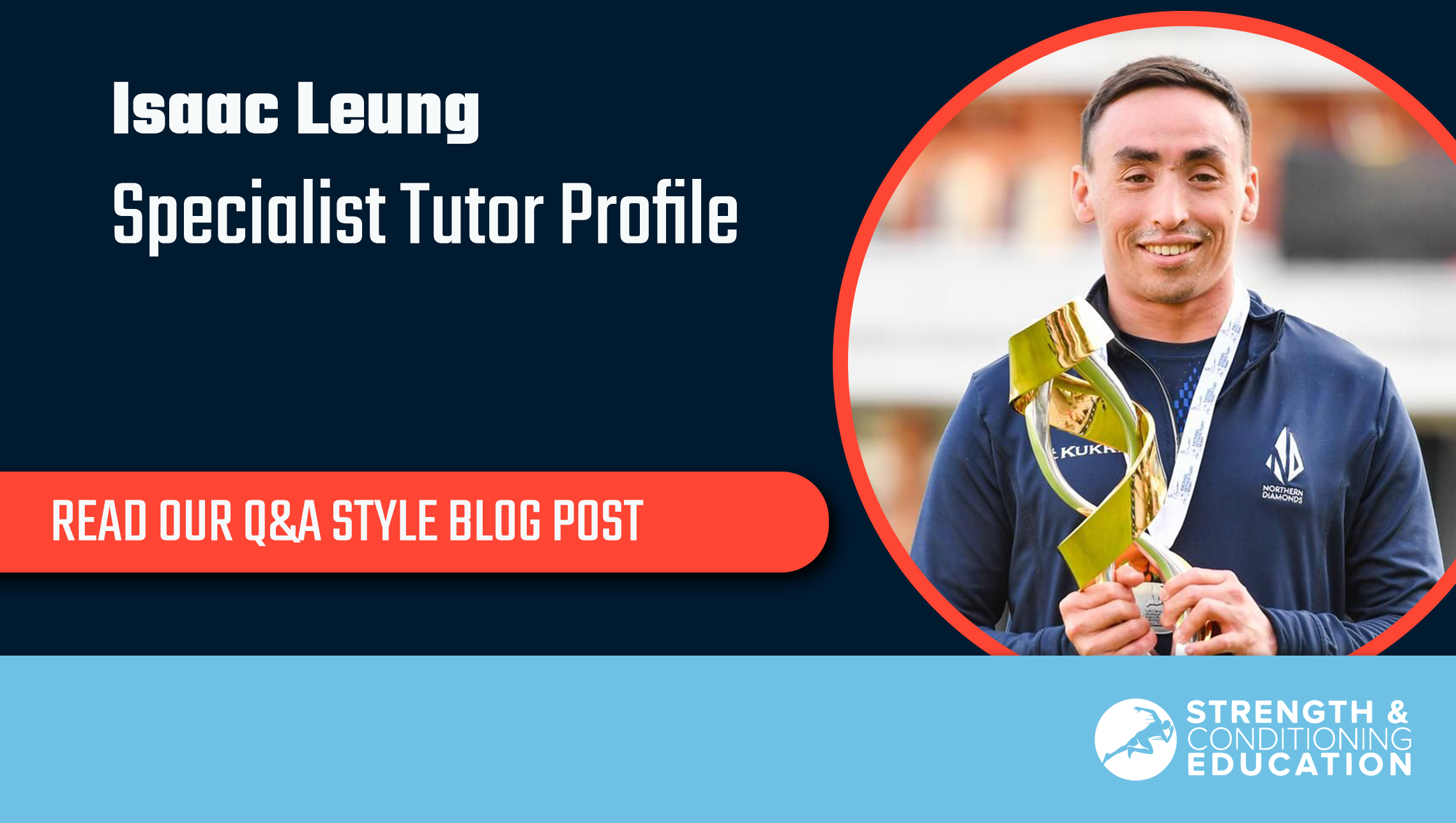
In this specialist tutor profile series we caught up with Specialist Training tutor: Isaac! Read our Q&A style blog below as she answers some of our questions ahead of the launch of our new course ‘Business and S&C’:
Introduction
Can you briefly describe your current role at Strength and Conditioning Education?
I act as a tutor, leading the way in helping coaches start and build a business coaching athletes.
What led you into the strength and conditioning industry?
I’ve enjoyed sports and fitness since childhood. I was always interested in the physical side of games and was motivated to improve my own performance as an athlete. Over time, I discovered I also loved influencing performance in others – playing a small part in their development or a team’s success and helping people reach their potential.
What qualifications and certifications do you hold?
– Master’s Degree in Strength & Conditioning, Leeds Beckett University
– Level 4 Strength & Conditioning certification
– UKSCA accreditation
– Level 3 Personal Training qualification
Can you share a bit about your career journey so far – where did you start, and how did you get to where you are now?
I began with a Sport and Exercise Science degree at Leeds Beckett, followed by a Master’s in Strength & Conditioning. I spent the early part of my career working in gyms — running personal‑training sessions and fitness classes while building experience.
My first break into sport came through a volunteer role with Yorkshire Women’s Cricket. That summer opportunity developed into a part-time role supporting the men’s, women’s, and academy squads at Yorkshire Cricket. When women’s cricket turned fully professional in 2020, I became Head S&C Coach, overseeing the full programme — seniors to academy and leading the department. I held this position for 3–4 years, also working with the Northern Superchargers in The Hundred and providing support for England Women’s Cricket camps.
After leaving pro sport, I established my own coaching business. Initially, I worked with general-population clients and offered S&C consultancy to a school across multiple sports. However, I wanted to align my work more closely with my passion and experience — and that led to the birth of Athletic Skills.
Originally, Athletic Skills focused on educating sports coaches in S&C, addressing knowledge gaps I noticed during my time in elite sport. Over time, I evolved the business to support S&C coaches and personal trainers who want to step away from general population training — helping them build a business coaching athletes.
Because I’ve experienced this journey myself — the transition from applying S&C knowledge to turning it into a sustainable athlete-focused business — I understand the challenges coaches face. That’s why I created Athletic Skills and the Train Athletes, Get Paid programme: to offer clarity, guidance, and support to anyone looking to follow the same path.
What other roles have you had outside of your work with Strength and Conditioning Education?
– Head S&C Coach for Yorkshire Women’s Cricket (Northern Diamonds) during their professional transition
– S&C staff for Northern Superchargers in The Hundred (franchise level)
– S&C support for England Women’s Cricket camps
– Running my own coaching business — supporting general population clients and youth athletes
– Delivering S&C consultancy in schools, helping multi-sport athletes through structured programming
– Founder of Athletic Skills and CEO Train Athletes, Get Paid — an education and mentoring business helping coaches and PTs find athlete clients, build their business, and move away from general population work
Approach to Coaching and Education
How would you describe your coaching philosophy or teaching style?
My philosophy centres on relationships and trust — whether I’m working with athletes or coaching other coaches. I believe building a strong connection is the foundation for genuine progress. When people feel understood, supported, and challenged appropriately, they grow.
I’m not a believer in a one-size-fits-all approach. Every athlete, coach, or student is different. So I adapt my coaching and teaching style based on an individual’s needs, learning style, and environment. Whether it involves building confidence, simplifying a complex concept, or giving direct feedback — I tailor my approach to ensure clarity and relevance.
My style is very application-focused. I want people to walk away not just knowing more, but doing more — whether that’s delivering a better session, running their first trial, or launching a coaching offer. My goal is to create practical momentum.
What do you enjoy most about delivering practical workshops?
Watching coaches experience that “lightbulb” moment — when theory clicks in real time — is incredibly rewarding. Whether it’s refining a cue, practicing a drill, or executing a movement improvement, there’s something powerful about hands-on learning.
Even with online workshops, that same energy can be maintained through breakout discussions, live feedback, and practical tasks. It’s not about the format — it’s about delivering an experience that can be actioned immediately. I strive to create environments where participants feel supported yet challenged. Whether in-person or online, it’s about helping coaches problem-solve, test their ideas, and leave with confidence and clarity.
How do you tailor your support to suit students with different learning styles or backgrounds?
My approach is built on action. I believe the best learning happens when you apply ideas in real-world settings. Every module I deliver is practical and focused on implementation. I encourage coaches to go out, run sessions, initiate conversations, and test what they’re learning.I recognise that coaches come from a variety of backgrounds — some academic, others hands-on; some transitioning from personal training, others starting fresh. I offer flexible frameworks that can be adapted to their learning style — whether that’s through visual aids, step-by-step systems, or real-life examples. The aim is always to provide tools that are simple, applicable, and transferable.
What common challenges do you see students face — and how do you help them overcome these?
Many Level 4 and S&C coaches struggle with the transition from “qualified” to “coaching athletes and running a business.” They often know the theory but don’t know how to attract clients, find athletes, or position themselves in a competitive landscape. I help them overcome this by providing business‑focused, practical frameworks: clarifying their niche, designing a compelling offer, building early credibility, having strategic outreach conversations, and confidently converting interest into paid clients. More than that — I guide them to shift from thinking like a coach to acting like a business owner.
Industry Insights
What trends or changes have you noticed in the strength and conditioning field in recent years?
A major shift I’ve seen is coaches increasingly moving away from pursuing paid roles in professional sport. The competition, limited positions, and often underwhelming pay have driven many to seek autonomy — to build something on their own terms. There’s a growing desire to coach athletes they’re passionate about and be valued for their expertise.
There’s also increasing demand at the grassroots and youth levels. Parents, schools, and local clubs are recognising the value of athletic development well before elite level. This presents real opportunity for coaches willing to position themselves professionally and deliver quality support. At the same time, the field is evolving — hybrid coaching models (in-person and online), the rise of personal branding, and greater emphasis on business and communication skills alongside technical ability.
Are there any myths or misconceptions in the industry that you’d like to set straight?
One of the biggest misconceptions is that qualifications alone lead to coaching opportunities. In reality, athlete clients look for coaches who can solve performance problems and communicate value — not just certificates. Another myth is that success only comes through working in professional sport. In truth, some of the most meaningful, impactful, and profitable work happens in local communities — coaching youth athletes, working with schools, and building relationships with clubs.
Finally, many coaches view sales and marketing as “sleazy” or irrelevant. But if no one knows what you do, who you help, or how to connect with you — your programme’s quality doesn’t matter. Communicating your value is just as important as programme design.
What advice would you give to someone just starting out in strength and conditioning?
Coach as much as you can — and don’t limit yourself to elite environments. Some of the best learning happens with grassroots athletes, community teams, friends, or local amateur clubs. Getting reps, building confidence, and learning to lead and adapt in real-world settings are invaluable. At the same time, build relationships. Networking online via LinkedIn, Instagram, or other platforms can open doors and get you noticed. Relationships are the foundation of success in S&C and coaching — people need to know and trust you before they’ll commit.
Start building a personal brand early. People buy into people, not just qualifications. Share who you are, how you coach, and who you help. That gives others a reason to connect and refer opportunities to you. Finally — remember that working in professional sport is not the only path. The industry has changed. It’s entirely possible to build a fulfilling, impactful business coaching athletes on your terms — earning a good income, making a real difference, and building something that lasts..
Continuing Development and Personal Practice
How do you stay current with developments in strength and conditioning practice or sports science?
For me, staying current isn’t about consuming research alone — it’s about staying connected to real-world coaching. I regularly speak with other coaches, practitioners, and professionals across different sports and levels. Networking and conversation are, in my view, among the most powerful tools to stay sharp — you learn what works on the ground, not just on paper. I also regularly listen to podcasts covering performance coaching, athlete development, business in sport, and leadership. They expose me to diverse perspectives and keep me questioning and growing.
Mentoring others — and having my own mentor — forms another key part of my development. Problem‑solving in real time, bouncing ideas off peers, and reflecting on what’s working (or not) helps me adapt and stay relevant as the field evolves.
What are your go-to resources for professional growth?
LinkedIn: A hub for connecting with coaches, practitioners, and industry professionals — and a source of real-time insight and discussion
Podcasts: A flexible way to absorb expert knowledge while travelling or working
Observing successful coaches: Whether live, online, or in collaboration — watching experienced practitioners coach, communicate, and adapt in real settings is often more valuable than any textbook
I believe professional growth comes from staying curious, staying connected, and being willing to observe and learn from the environments around you.
Are there any particular athletes, coaches, or mentors who’ve influenced your approach?
I’ve been fortunate to work with some amazing coaches, athletes, and mentors along the way. In my early days at Yorkshire Cricket, Ian Fisher and Pete Sim were standout mentors and supportive colleagues. They not only guided me but gave me the freedom to coach, make mistakes, and get stuck in — which was key to my development. Their approach helped shape the way I coach today and continues to influence my philosophy.I also had the opportunity to work closely with some excellent technical coaches who gave me ownership during training sessions. They allowed me to integrate my coaching with the technical side of performance, which helped me understand how to contribute effectively as part of a wider coaching team. On the business side, Brendan Chaplin has been an incredible mentor — helping me learn the ropes of building a business, offering support and inspiration during tough times, and showing me what’s possible. His guidance has played a huge role in getting me to where I am today, both personally and professionally.
Highlights and Impact
Can you share a memorable success story from your work – either with a client, team, or student?
One of the most memorable transformations I helped facilitate involved a newly qualified coach who felt lost and uncertain what to do next. Through mentoring, we identified their passion — padel tennis. Together, we crafted a tight offer, planned a free trial, and used targeted outreach to engage potential clients. Within weeks, they had secured five paying clients, regained confidence, and began earning what they were worth doing something they loved. Watching that shift — from uncertainty to momentum — is one of the most fulfilling experiences I’ve had.
What’s been your proudest moment as a coach or educator so far?
– Supporting an athlete through a year-long rehabilitation journey, and seeing them perform in front of a crowd on TV — a powerful reminder of the value of patience, trust, and consistent action.
– Playing a small part in a team’s success over an entire season that culminated in winning a trophy at Lord’s Cricket Ground — being part of shared triumph felt special
– Helping a coach transition from general‑population training to a successful athlete‑coaching business — seeing their meaningful career transformation brings long-term satisfaction
How do you measure your impact on students or athletes?
Impact isn’t just about outputs — it’s about progress and transformation. I track:
– When a coach lands their first athlete client or delivers their first paid session
– When they take action on ideas they were hesitant about before
– Growth in their confidence, clarity, and consistency
– Feedback from clients and athletes, real-world results, and progression over time
I encourage regular reflection (weekly and monthly) for coaches to review their implementation — outreach, session delivery, content output — and use those reflections to guide ongoing development.
Personal Side
What do you enjoy doing outside of coaching and teaching?
I love to travel — exploring new places fuels my creativity and gives a fresh perspective. Recently, I’ve been to South America, Bali, New Zealand, and South Africa. I also enjoy playing sport — cricket, padel tennis, golf, and previously football.
Outside sport, I’m a keen baker — I enjoy the process of creating something, experimenting with recipes, and taking time away from coaching to relax and reset.
If you weren’t working in strength and conditioning, what do you think you’d be doing?
I’ve always liked numbers and structure, so I could see myself working in accounting or finance. I also love travel — so any role that combines numbers with international work might appeal. Having said that, sport has always been a part of my life. Even if I weren’t coaching, I’d likely stay connected to athletic development or performance in some way.
Favourite lift, workout, or recovery method?
I enjoy a good running session to clear my mind, stick my headphones on, and escape from the world for a while. I especially love running in new cities and locations when I travel — it’s a great way to explore. In the gym, I enjoy a heavy legpress or a challenging power clean. I also love playing sports and adding some competition into the mix, whether it’s cricket, padel tennis, or golf.
What motivates you to keep doing what you do every day?
What keeps me going is watching coaches grow — not just technically, but in confidence, clarity, and self‑belief. I know how frustrating it is to feel stuck after qualifying but not seeing a path forward. Helping someone take the leap to coaching, find athlete clients, and build a business gives real purpose.
I’m also driven by a bigger vision: raising the standard of athlete support beyond elite sport. There are countless athletes who need quality coaching at grassroots and youth levels. I want to help coaches realise they don’t need a pro badge to make a real impact. Watching that shift — from hesitation to momentum, from generalist to passionate specialist — is what makes this work worthwhile.
Enrol Today!