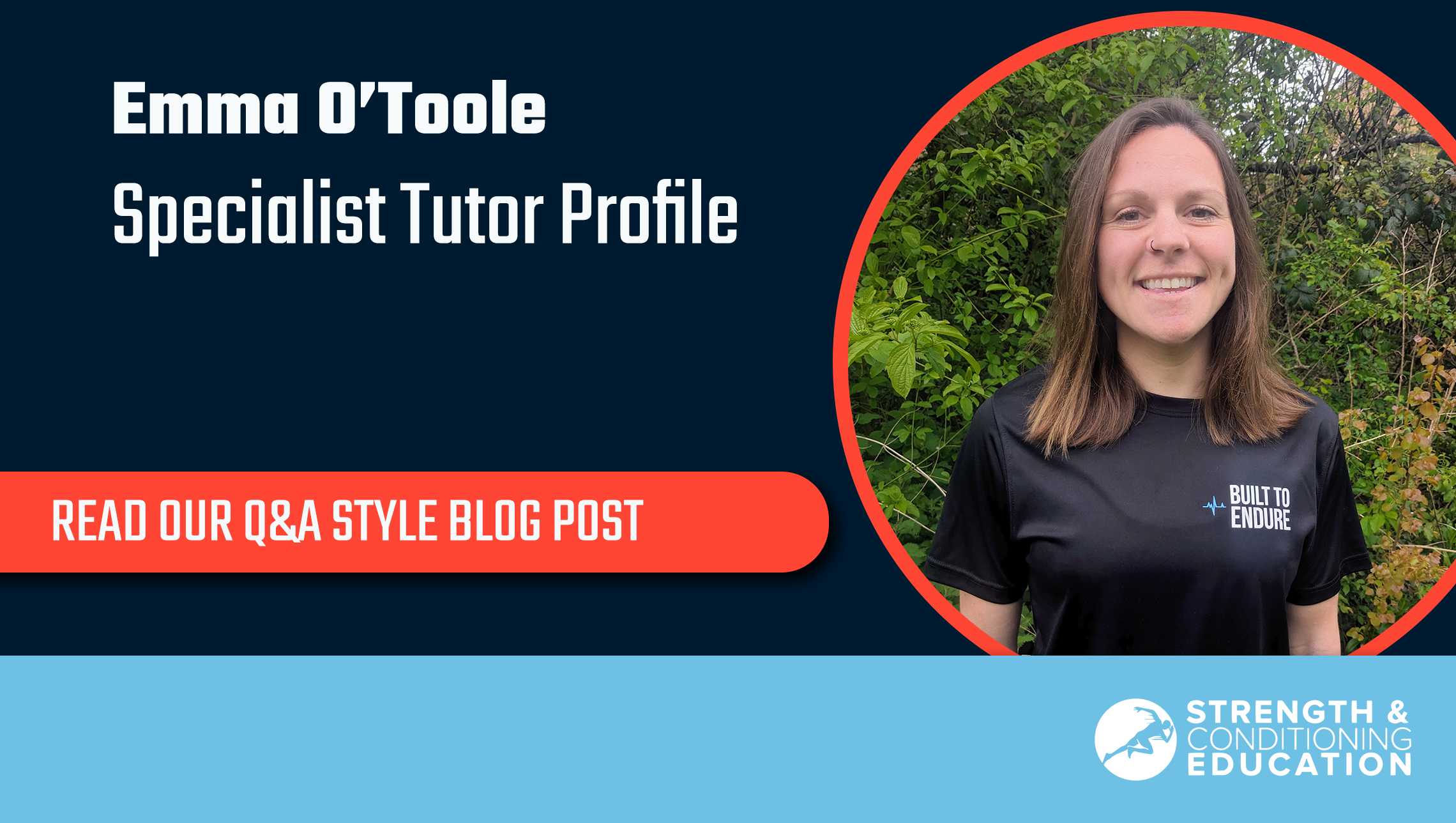
In this specialist tutor profile series we caught up with Specialist Training tutor: Emma O’Toole! Read our Q&A style blog below as she answers some of our questions ahead of the launch of our new course ‘S&C for Endurance’:
Introduction
Can you briefly describe your current role at Strength and Conditioning Education?
My current role is as a course tutor on the Specialist Training: S&C for Endurance programme, where I support coaches in developing the knowledge and skills to apply strength and conditioning effectively with endurance athletes.
What led you into the strength and conditioning industry?
Like many endurance athletes, my journey was shaped by repeated injuries. Competing at a high level, I kept hitting setbacks that traditional training couldn’t solve. Strength and conditioning gave me the tools to not just recover, but to come back stronger and perform at a higher level than I was at before. That experience lit the fire so to speak; I wanted to help other endurance athletes avoid the mistakes I, and so many others, made, reduce their injury risk, and unlock their true performance potential..
What qualifications and certifications do you hold?
– BA (Hons), University of Southampton
– Level 4 Strength and Conditioning Education Certification
– Personal Training and endurance sport qualifications
Can you share a bit about your career journey so far – where did you start, and how did you get to where you are now?
I began my career as an endurance athlete, representing Great Britain’s Age Group team in triathlon and competing for GB Masters in cycling. Along the way, I faced significant injuries, which ultimately led me to strength and conditioning as the solution. I started coaching young, teaching spin classes at 18, then moving into personal training, before founding BUILT TO ENDURE. That mix of personal experience, hands-on coaching, and educational delivery has shaped my journey and led me to my current role in endurance sports.
What other roles have you had outside of your work with Strength and Conditioning Education?
I am the founder of BUILT TO ENDURE, a coaching and education company for endurance athletes. Beyond that, I’ve contributed to industry-leading platforms such as TRX and Precision Fuel & Hydration, featuring on podcasts and writing articles. Earlier in my career, I worked as a secondary school teacher, which gave me valuable experience in tailoring my coaching style to suit different learning needs. I’ve also had the privilege of working with the British Cycling Paracycling team as a pilot rider for visually impaired athletes.
Approach to Coaching and Education
How would you describe your coaching philosophy or teaching style?
My coaching philosophy is simple: coach the athlete in front of me- I want all the details! Their history, their goals, and where they are right now. From there, I build a plan that moves them forward while meeting them exactly where they are today.
What do you enjoy most about delivering practical workshops?
The human element! There is something about a room of like-minded individuals all sharing ideas, asking questions and supporting one another.
How do you tailor your support to suit students with different learning styles or backgrounds?
No two students learn the same way, so I make a point of finding the approach that works best for each student. I often combine audio-visual content with clear written resources, but I stay open-minded and flexible, knowing that approach might not work for everyone.
What common challenges do you see students face — and how do you help them overcome these?
Many students know the theory inside out, but the challenge is having the confidence to actually apply it in practice. They second-guess themselves, worry about “getting it wrong,” or get bogged down on feeling as if they need to study more. I help them overcome this by breaking bigger tasks into smaller, achievable steps, and encouraging them to focus on the athlete in front of them. I also build in reflection after each attempt and provide constructive feedback, so their confidence grows with every step.
Industry Insights
What trends or changes have you noticed in the strength and conditioning field in recent years?
The emergence of new technology has been quite a big one. It is easy to get lost in the weeds with data and gadgets, but for me, it’s important to remember that great coaching ultimately comes down to the athlete–coach relationship and that is something that no piece of technology can ever replace. I’ve also noticed a shift towards specialism, which I see as a really positive step forward for the field.
Are there any myths or misconceptions in the industry that you’d like to set straight?
A common misconception is that endurance athletes don’t need strength training… that high-torque, low-cadence cycling drills or hill sprints for runners are “enough .” They’re not. True strength training for endurance athletes develops qualities that endurance sports alone can’t. But you’ll have to go through the course to find out exactly why!
What advice would you give to someone just starting out in strength and conditioning?
Learn as much as you can from every source available: courses, books, podcasts, and other coaches. Don’t just accept things at face value: challenge ideas if you disagree, and be curious enough to find out more. Collaborate with other coaches, share knowledge, and never waste an opportunity to learn and grow.
Continuing Development and Personal Practice
How do you stay current with developments in strength and conditioning practice or sports science?
CPD, keeping up with research, coaching mastermind sessions with other S&C coaches in the endurance space, podcasts and courses.
What are your go-to resources for professional growth?
My go-to resources are research articles on PubMed and journals such as the Strength and Conditioning Journal. Slightly off-piste, but I also learn from what other coaches are doing with their athletes: what’s working right now and what isn’t?
Are there any particular athletes, coaches, or mentors who’ve influenced your approach?
There are several! Probably the best piece of advice I was given luckily came early on into my career where I was told by a mentor to think beyond the textbook. That mentor helped me realise there isn’t one universal right answer, the best approach is always the one that works for the individual athlete in front of you and that perspective has shaped my coaching ever since.
Highlights and Impact
Can you share a memorable success story from your work — either with a client, team, or student?
There are many! One that really stands out to me isn’t about podiums, (though I’m proud of those too). I worked with a recreational cyclist in his 70s who was returning to the sport after more than 30 years, training for Lands End to John o’Groats. His preparation was going well, until a horrendous crash during a sportive left him with multiple breaks, including a broken neck. At his age, the fear was immense. The clinician told him he was lucky to be walking, and credited his “well above average” bone density and strong musculoskeletal system to our strength and conditioning work. He not only recovered from that crash, but is now happily back training again.
How do you measure your impact on students or athletes?
The numbers and performances are valuable feedback, but they’re the end result and race day can be so unpredictable that it’s really only a snapshot. For me, the true measure is the athlete-coach relationship; seeing athletes grow in how they carry themselves, handle setbacks, and approach training and performance with confidence.
Personal Side
What do you enjoy doing outside of coaching and teaching?
I enjoy my own training and pushing the boundaries of my body with endurance sports. I also enjoy fostering dogs for a local charity and surfing.
If you weren’t working in strength and conditioning, what do you think you’d be doing?
I think I would be working for an endurance federation like British Triathlon, British Cycling or British Athletics.
Favourite lift, workout, or recovery method?
Romanian deadlifts! I love coaching them and doing them myself; they’re an invaluable exercise for endurance athletes.
What motivates you to keep doing what you do every day?
My athletes motivate me and being better for them. As well as that, it’s the hunger to help more aspiring coaches support endurance athletes as strength and conditioning training has received a pretty bad rap for endurance athletes over the years. It’s a great feeling to be helping to re-write that narrative.
